
Sooner or later, anyone starting a journey into mechanical watches runs into one name that keeps coming up in every serious conversation about value for money: Orient.
This Japanese watchmaker has spent decades proving that a high-quality automatic movement doesn’t have to come with a luxury-brand price tag.
In this Orient watches review, we cover Orient’s history from its founding, explain the types of movements it uses and the calibers behind them, walk through its most sought-after model lines, and break down what actually drives the price of an Orient watch, plus how to check a piece is genuine before you buy.
Watches Prime carries a wide range of genuine Orient automatics, with worldwide shipping and a real manufacturer warranty on every piece, so you can browse the current lineup with some peace of mind wherever you’re ordering from.
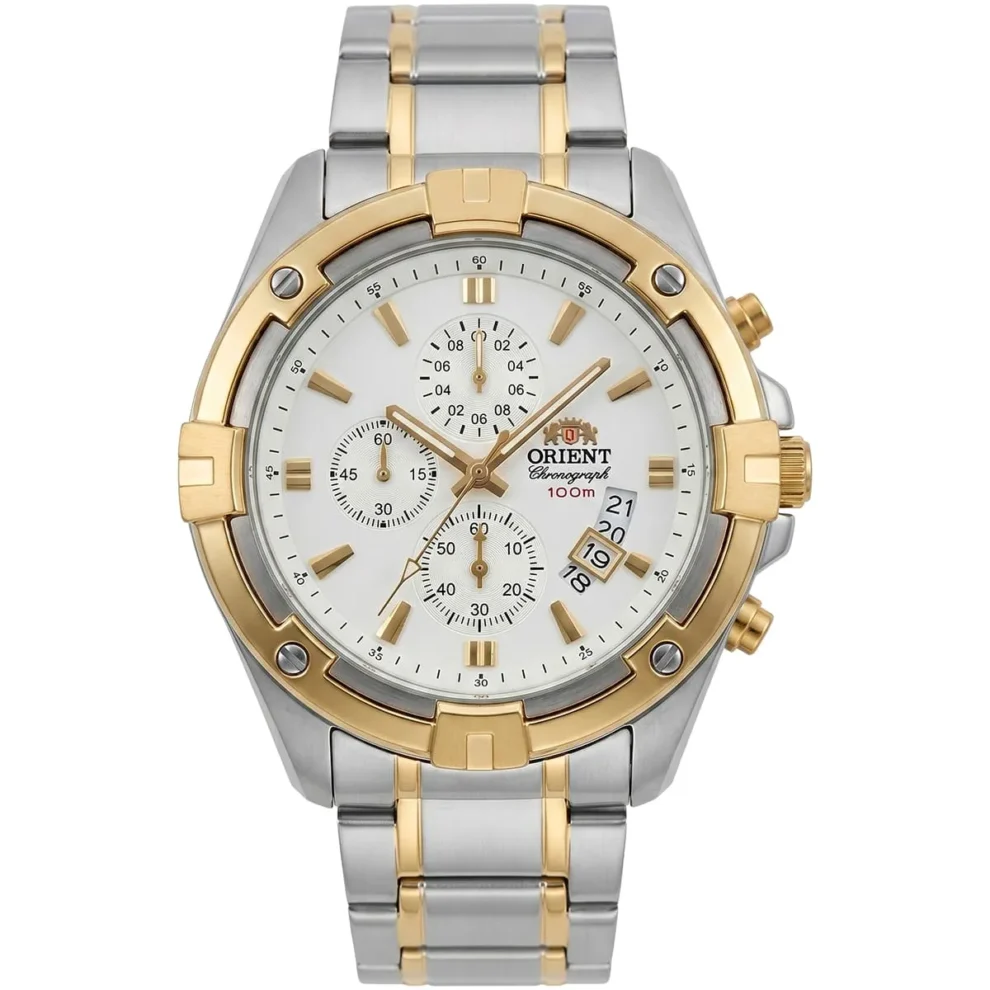
Orient Men’s Chronograph Two-Tone Silver & Gold Watch

A Brief History of Orient, From Founding to Today
Orient Watch Co. was established as an independent company in Japan on July 13, 1950, focusing primarily on mechanical watchmaking, both automatic (self-winding) and hand-wound movements.
That early specialization in mechanical movements is what built the brand’s reputation among enthusiasts over the decades that followed.

In 2009, Orient became a functional subsidiary of the Seiko Epson Group, while retaining its own brand identity and product line.
In an official statement dated September 6, 2016, Epson announced the start of discussions to restructure Orient, to combine Orient’s watchmaking capability with Epson’s vision for wearable devices.
According to that statement, Orient was at the time a wholly owned subsidiary of Seiko Epson with capital of 100 million yen, headed by Masayuki Kawana.
Starting in April 2017, Orient’s domestic sales functions in Japan were transferred to an Epson subsidiary, while the rest of the company’s functions were absorbed directly into Epson, completing the full integration between the two brands.
Orient movements are still manufactured in-house today by an Epson group subsidiary in the city of Yuzawa, Akita Prefecture, Japan.
Read also: Orient vs Seiko: A Full Comparison of Japan’s Best Watches
Types of Orient Movements: Automatic and Quartz
Historically, Orient has produced two main categories of movement, mechanical (both automatic and hand-wound) and quartz, alongside models powered by light (solar) and radio-controlled timekeeping within its Japan-market lineup.
The automatic movement remains the one most closely tied to the brand’s reputation among collectors.
1. Automatic (Self-Winding) Movement
Orient’s automatic movement relies on the natural motion of the wearer’s wrist to wind the internal mainspring, with no battery required.
This is the movement type that built the company’s core reputation from its founding, and it remains the preferred choice for serious mechanical watch enthusiasts.
2. Quartz, Solar-Powered, and Radio-Controlled Models
Alongside its mechanical watches, Orient has also produced conventional quartz models, as well as solar-powered pieces and radio-controlled models for improved timekeeping accuracy.
This range gives buyers a choice based on whether they prioritize traditional mechanical character or day-to-day practical accuracy.
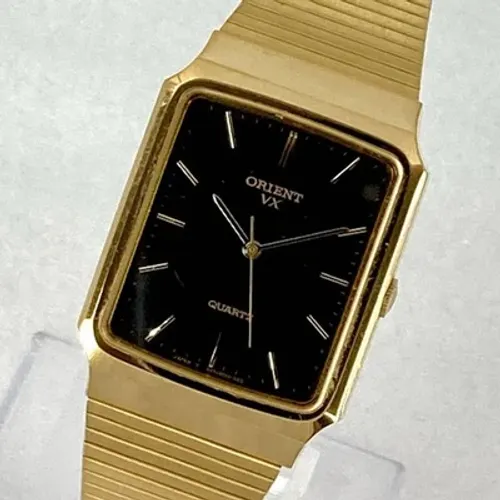
Enthusiasts often notice that the seconds hand on an automatic movement sweeps smoothly and continuously, while on a quartz movement it ticks once per second.
This simple visual difference is usually the first thing a new buyer learns to spot when telling the two movement types apart.
Read also: Orient Automatic Watch Review: Features, Accuracy, and Value Tested
Orient’s Most Popular Model Lines
Orient enthusiasts’ interest generally splits across four main product lines, each with its own following, price point, and use case.
Understanding the differences between them can save a buyer both time and money.
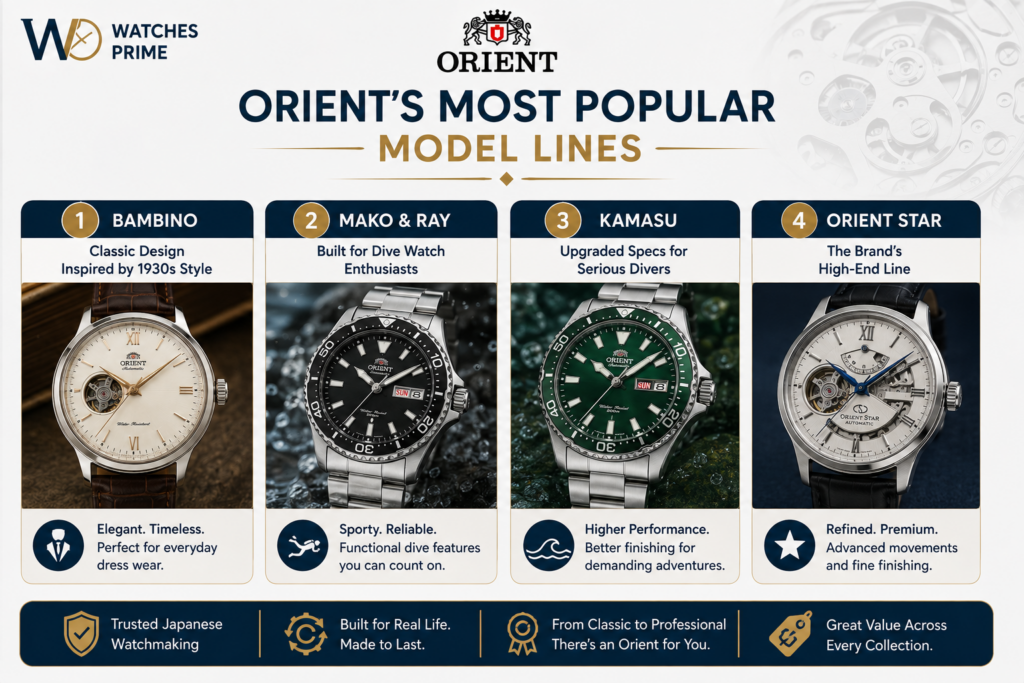
1. Bambino: Classic Design Inspired by 1930s Style
The Orient Bambino is the brand’s most globally recognized model, known for its domed crystal and a clean dial free of excess numerals.
It was originally designed to echo old hand-wound pocket watches, which explains its popularity among fans of classic, elegant design.
Bambino comes in multiple leather strap colors and dial color options depending on the version. Exact case dimensions and crystal type vary between references, so it’s worth checking the specific product listing before buying.
2. Mako and Ray: Built for Dive Watch Enthusiasts
The Mako and Ray lines target sport and dive watch fans, featuring a unidirectional rotating bezel for tracking dive time — a genuinely functional feature, not just decoration. Exact water resistance ratings vary by reference and should be confirmed from each model’s specifications.
The main difference between Mako and Ray usually comes down to how the crystal is set into the case, a detail that visually distinguishes the two models despite their similar use case.
3. Kamasu: Upgraded Specs for Serious Divers
The Orient Kamasu is a step up from Mako and Ray in terms of build quality and case finishing, aimed at serious divers or enthusiasts looking for more professional-grade specs.
Exact water resistance again varies by reference and should be checked directly on the product page.
Kamasu’s case design sets it apart from Orient’s older sport models, making it a logical choice for anyone wanting to move up from entry-level dive watches without a major jump in price.
4. Orient Star: The Brand’s High-End Line
Orient Star sits at the top of the brand’s lineup, built around more accurate movements and more visible hand-finishing on internal components.
This line targets more advanced watch enthusiasts looking for an experience closer to premium Japanese brands like Grand Seiko, but at a relatively lower price point.
Read also: Uncovering Where Fossil Watches Are Made Around the World
What Determines the Price of an Orient Watch?
Orient prices, new and used, vary considerably depending on several factors: the specific model, the condition of the piece, and whether the original box and papers are included.
As a general rule, women’s Orient models tend to sit toward the lower end of the price range, while men’s models span a much wider range depending on specifications and design.
Discontinued or rarer models can command a premium regardless of which product line they belong to.
Rather than relying on undocumented prices from individual listings, it’s always worth comparing current prices against an authorized dealer’s catalog to see what similar references are actually selling for.
Read also: Are Fossil Watches Any Good? An Honest Buying Guide
How to Spot a Genuine Orient vs. a Fake?
Because Orient’s sport models in particular are widely copied, buyers need to know exactly what to check before completing a purchase — especially when buying from an unofficial source.
1. Check the Serial Number Against the Warranty Card
Every genuine Orient watch has a serial number engraved on the case back, and this number should match any accompanying warranty document or certificate.
A missing serial number, or unclear/shallow engraving, is a strong red flag for a non-genuine piece.
Read also: How to Read an Orient Watch Serial Number and Verify It
2. Case Weight and Finishing Quality
Orient uses specific metals with a particular weight and quality, while counterfeits generally use lighter, cheaper materials. The weight difference is noticeable as soon as you hold the watch, and a genuine case shows precise finishing on its edges, without roughness or sharp edges.
| Inspection Point | Genuine Watch | Counterfeit |
| Automatic movement sound | Quiet, consistent hum | Rough or occasionally loud |
| Seconds hand motion | Smooth, continuous sweep | Jerky or irregular |
| Dial printing | Sharp, clean edges | Blurry or misaligned printing |
| Case back | Deep, clear engraving | Shallow or mismatched engraving |
The safest way to avoid all of these risks is to buy Orient watches from a retailer that directly guarantees authenticity.
Shop Authentic Orient Watches At Watches Prime
Whether Orient’s honest simplicity or a broader Japanese lineup fits your style, buying from a trusted source is what protects both authenticity and after-sales support.
- Trusted online store since 2013
- Local and worldwide shipping
- Easy 14-day returns
- Real product warranty
- 100% secure checkout via Instapay, Vodafone Cash, and cash on delivery
- Over 300,000 satisfied followers
Browse the Orient watches category now or visit the full shop to find your next Japanese watch.
Conclusion
Orient watches strike a balanced combination of genuine Japanese movement quality and reasonable pricing, making them a solid choice for both enthusiasts and first-time buyers alike.
Understanding the differences between the Bambino, Mako/Ray, Kamasu, and Orient Star lines helps any buyer pick the model that best fits their intended use and actual budget.
Buying from a trusted, authorized source that guarantees authenticity and a real warranty remains the single most important step in protecting any Orient watch purchase, regardless of which model you choose.
Frequently Asked Questions
Is Orient owned by Seiko?
Orient is a subsidiary of the Seiko Epson Group, not of Seiko Watch Corporation directly. It became part of Seiko Epson in 2009, and in 2016–2017 its remaining functions were more fully integrated into Epson, though it kept its own brand identity and product line.
Are Orient watches good quality for the price?
Yes, Orient is widely regarded among enthusiasts as one of the best value-for-money brands for in-house automatic movements, since it designs and manufactures its own movements rather than sourcing them from a third party, which is unusual at this price point.
What’s the difference between Orient and Orient Star?
Orient Star is the brand’s higher-end line, using more accurate movements with more visible hand-finishing on internal components. Standard Orient lines like Bambino, Mako, Ray, and Kamasu sit at a more accessible price point with simpler finishing.
Do Orient watches need servicing?
Yes. Like any mechanical automatic watch, an Orient movement benefits from professional servicing every few years to keep it running accurately and to replace lubrication that degrades over time.
How can I tell if an Orient watch is real or fake?
Check the serial number on the case back against the warranty card, compare the weight and case finishing to official photos, and listen to the sound and motion of the movement; a genuine automatic movement runs quietly with a smooth, continuous seconds hand, unlike the jerkier motion often seen in counterfeits. Buying from an authorized dealer is the most reliable safeguard.
Which Orient model is best for a first mechanical watch?
The Bambino is usually recommended as an entry point thanks to its classic design and accessible price, while the Mako or Ray suit buyers who want a sportier, dive-ready watch as their first automatic.